






Foreign scholars have conducted extensive research on the lubrication mechanism of bearing grease, and the results confirm that:
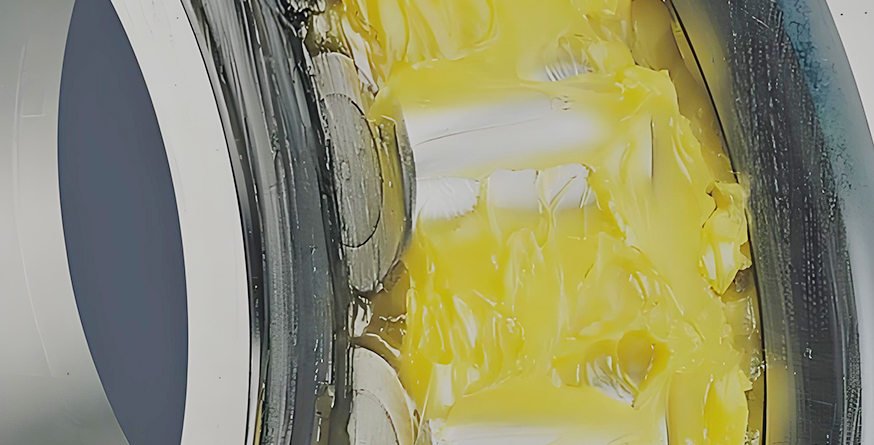
After undergoing complex flow in the initial stage, the grease inside rolling bearings will enter a stable distribution state. Ultimately, only a tiny amount of grease remaining in the friction areas and in a fluid state plays the main lubricating role, while the grease remaining in the housing is in a static state, i.e., it does not participate in lubrication directly. However, the bearing grease retained in the housing can perform a sealing function to prevent the loss of the fluid grease retained in the friction areas.
Experiments show that if the grease in the housing is removed after the bearing has been in operation for 50 hours, the wear of the bearing will increase significantly. At the same time, the base oil separated from the static grease inside and outside the bearing will enter the friction surface under the action of heat, vibration and other factors to participate in the lubrication process.
Obviously, it is unnecessary to fill the bearing with excessive grease. Due to the poor oil film repair ability of grease, overfilling will instead deteriorate the lubrication state of the bearing. Therefore, determining the appropriate filling amount of bearing grease is crucial. It can be seen that both excessive and insufficient filling of grease will cause the bearing temperature to rise, failing to ensure that the bearing is in an optimal operating state continuously.
I. Hazards of Excessive Grease Filling
Triggering Sealing Problems, Increasing Energy Consumption and Damaging the Grease Itself
Temperature rise during operation will lead to seal failure, increase equipment energy consumption, and have an adverse impact on the performance of the grease itself. For example, excessive grease filling in a motor will cause an increase in power consumption and even motor failure in severe cases.
Aggravating Bearing Wear and Grease Deterioration
Taking bearings as an example, excessive grease churning violently in the bearing cavity will increase the rotational resistance of the bearing, leading to temperature rise and increased energy consumption; the temperature rise will in turn accelerate the oxidation of grease (premature deterioration and shortened service life), and also promote the accelerated separation of base oil contained in the grease — it should be noted that grease can play a lubricating role mainly relying on its contained base oil.
Residual Thickener Causing Subsequent Lubrication Failures
After the base oil is lost from the grease, thickeners will remain. These thickeners will gradually dry and harden, resulting in the newly added grease failing to flow fully to the core part of the bearing, causing poor lubrication, and then leading to bearing wear and even failure. In addition, the hardened grease lumps may fall off and break, and then be brought into the bearing, further exacerbating damage.
Damaging the Sealing Structure and Introducing External Impurities
Excessive grease injection will increase the pressure on the sealing parts, leading to cracking and failure of the seals, resulting in loose sealing, which in turn introduces impurities and moisture, and ultimately damages the bearing.
Pressure Risks of Grease Gun Injection
When using a grease gun for injection, attention should be paid to the pressure bearing capacity of the sealing parts. The pressure of some grease guns can reach 15,000 pounds per square inch (psi), while the pressure bearing capacity of ordinary lip seals is only about 500 pounds per square inch (psi), so the pressure of the grease gun must be controlled reasonably.
Special Hazards to Motors
The hazards of excessive grease filling in motors are similar to those of bearings, but additional problems may occur: excessive grease may leak onto the motor windings and dry on the surface of the windings, leading to poor heat dissipation of the windings.
II. Grease Filling Principles for Rolling Bearings
(1) Under normal circumstances, bearings should not be completely filled with grease, and the filling amount should be 1/2-3/4 of the total space in the bearing cavity;
(2) For horizontally mounted bearings, the filling amount should account for 2/3-3/4 of the inner cavity space;
(3) For vertically mounted bearings, the filling amount should be 1/2 (upper side) and 3/4 (lower side) of the cavity space respectively;
(4) In polluted environments, for low or medium-speed bearings, all spaces in the bearing and bearing housing should be filled with grease;
(5) Before filling high-speed bearings with grease, the bearings should first be immersed in high-quality lubricating oil (usually the base oil of the grease to be filled), to avoid bearing burnout due to insufficient grease on the friction surface during startup.
III. How to Fill Grease Reasonably
(1) Core Measures to Prevent Excessive Grease Filling
First, determine a reasonable grease filling amount; second, formulate operating specifications for the grease filling amount. After adding or replacing grease, close attention should be paid to the equipment's temperature, noise, vibration and other indicators, and check for oil leakage. For important equipment, special monitoring tools can also be used for monitoring.
(2) Calculation Method of Grease Filling Amount
The grease filling amount of bearings can be calculated with reference to the following formula:
Formula 1: G = 0.005DB
Where:
G = Grease filling amount (unit: gram, g)
D = Bearing outer diameter (unit: millimeter, mm)
B = Bearing width (unit: millimeter, mm)
Or Formula 2: G = 0.114DB
In this formula, the units of D (bearing outer diameter) and B (bearing width) are both inches (inch).
If a grease gun is used for injection, the grease output per time of the grease gun must be calculated first. The grease gun can be calibrated with an electronic scale to determine the required number of injections.
(3) Other Methods to Prevent Excessive Grease Injection
Feeling the Grease Injection Resistance: During the injection process, if the resistance increases, injection becomes difficult or a large reaction force is felt, the injection should be stopped immediately.
Keeping the Oil Outlet Unobstructed: Ensure the grease outlet is unobstructed during injection to prevent dry and hardened grease from clogging the oil hole.
Using Auxiliary Tools: Convenient auxiliary accessories can be used when necessary, such as grease gun pressure gauges, grease nozzles with pressure relief function, etc.
Controlling the Grease Injection Speed: Injection should be carried out slowly; too fast a speed is likely to cause sealing problems and is not conducive to the uniform distribution of grease in the bearing.