






I. Causes of Bearing Overheating and Seizure
1. Improper Fit Between Bearing Outer Ring and Bearing Housing Bore, or Inner Ring and Shaft During Assembly
During assembly, bearings are sometimes directly replaced and installed without repairing or measuring the inner bore of the bearing housing. After trial operation, excessive temperature is found. Inspection and measurement reveal that the bearing housing bore has deformed, causing the bearing outer ring to be squeezed. This reduces the radial clearance of the bearing, leading to uneven rotation and increased wear of the rolling elements; if the fit clearance between the bearing inner ring and the shaft is too large, the inner ring will rotate relatively with the rolling elements and the shaft, and friction will cause bearing overheating and vibration.
2. Improper Control of Bearing Heating Temperature or Uneven Heating During Assembly May Cause Bearing Deformation
In hot-fitting operations, if the temperature of the adjusted bearing heater is too high, it will instead reduce the hardness and precision of the bearing, leading to increased bearing temperature, wear and damage; uneven heating will cause bearing deformation, uneven clearance, and excessive local temperature.
3. Improper Adjustment of Bearing Clearance During Assembly
In practical work, some installation operations only rely on hand feel for debugging, resulting in excessive or insufficient clearance that cannot meet production needs:
If the axial clearance is too small, it is easy to cause bearing overheating, accelerate pitting corrosion, and even lead to jamming or adhesion damage of rolling elements in severe cases;
If the axial clearance is too large, it will increase the impact force of the kinematic pair, reduce stiffness, cause abnormal noise during operation, and even trigger severe vibration or cage damage.
4. Oil Seal Issues
An oil seal is a component used to seal a rotating shaft in mechanical equipment. The cavity where it is located is basically stationary, so the oil seal is also called a rotary shaft lip seal. For oil seals with a secondary lip, the secondary lip plays a dust-proof role, preventing impurities from invading and thus extending the service life of the oil seal. However, the secondary lip often suffers from excessive friction due to poor lubrication, leading to dry friction and ultimately oil seal damage. Therefore, when installing a double-lip oil seal, it is essential to fill the space between the two lips with lubricating grease.
5. Failure to Consider Thermal Expansion and Contraction of the Shaft During Installation of Thermal Equipment, Resulting in Excessive Heat Generation Due to Extrusion of the Free End Shaft During Operation
For thermal equipment, if no space is reserved for the thermal expansion and contraction of the shaft due to temperature changes during the installation phase, the free end of the shaft will be squeezed during operation, generating a large amount of heat and causing bearing overheating.
6. Spacer Dimension Problems
During assembly, if the spacer dimensions are not carefully calibrated before direct assembly and trial operation, the temperature of the equipment will rise rapidly after a period of operation. The outer ring dimension of the bearing is limited by the end cover and bearing housing; if the spacer dimension is too small, the inner ring dimension of the bearing needs to be adjusted by a round nut, which ultimately reduces the axial clearance of the bearing and causes overheating during operation.
7. Lubrication Issues
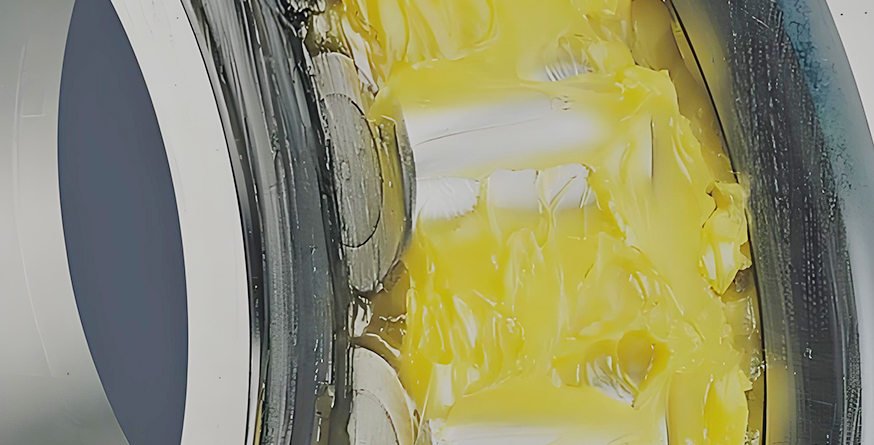
The filling amount of lubricating grease in the bearing must be appropriate: excessive filling will increase friction torque and cause the bearing temperature to rise; insufficient filling will fail to form reliable lubrication and lead to dry friction. Under normal circumstances, the suitable filling amount of lubricating grease is 1/3~1/2 of the total internal clearance volume of the bearing, so an appropriate amount of lubricating grease should be regularly injected according to usage requirements.
If oil cut-off occurs during equipment operation, the bearing without lubrication and cooling will heat up rapidly and be damaged in a short time.
II. Treatment Measures for Bearing Seizure
To address bearing seizure, it is first necessary to strictly inspect installation, lubrication, cooling and heat dissipation links, ensure that the shape and tolerance dimensions of the bearing housing, shaft and other accommodating parts are qualified, the bearing itself meets quality standards, and strictly follow the equipment manual or maintenance plan for operation to avoid bearing seizure from the source.
If seizure has already occurred, the bearing inner sleeve must first be cut and removed, followed by processing the shaft: the dimensions and tolerances of the shaft can be repaired by spraying or other methods, and then reassembled as required. If the shaft is an important component, non-destructive testing must be performed after repair to ensure the shaft quality is qualified; if necessary, the shaft should be directly replaced with a new one.